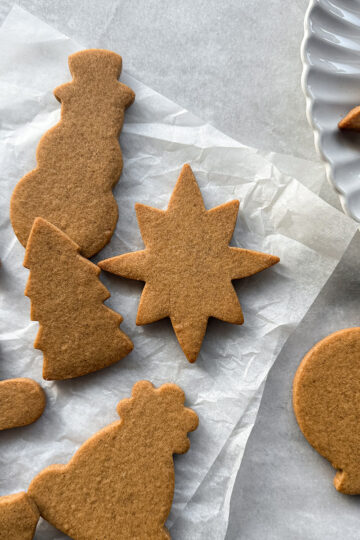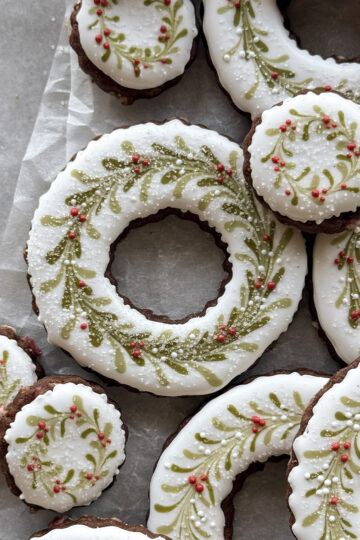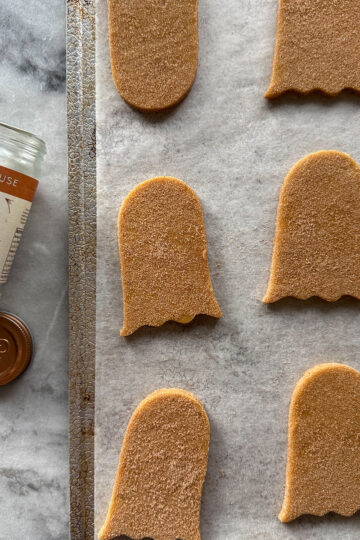
I was tempted to title this recipe “the very best cut out cookies”, but throwing around the word “best” is a little overdone on the internet. However, these really are the best. I promise.
My ideal cut out cookie is not a typical sugar cookie, which has a higher ratio of sugar to butter than my recipe. This is probably entirely related to the way I grew up, as we only ever made one recipe as cut out cookies: the Betty Crocker spritz cookie recipe, which is much less sugar by comparison to a classic sugar cookie recipe. For years, I have worked on this recipe, tweaking it here and there to make it ideal for decorated cut out cookies, whether you prefer royal icing or buttercream decorating. It’s also delicious baked crunchy with sugar on top, similar to a danish butter cookie.
This cookie is buttery, sweet but not too sweet, crisp edges with a soft chewy center, and delicious baked thin & crisp or thick & soft depending on your preference.
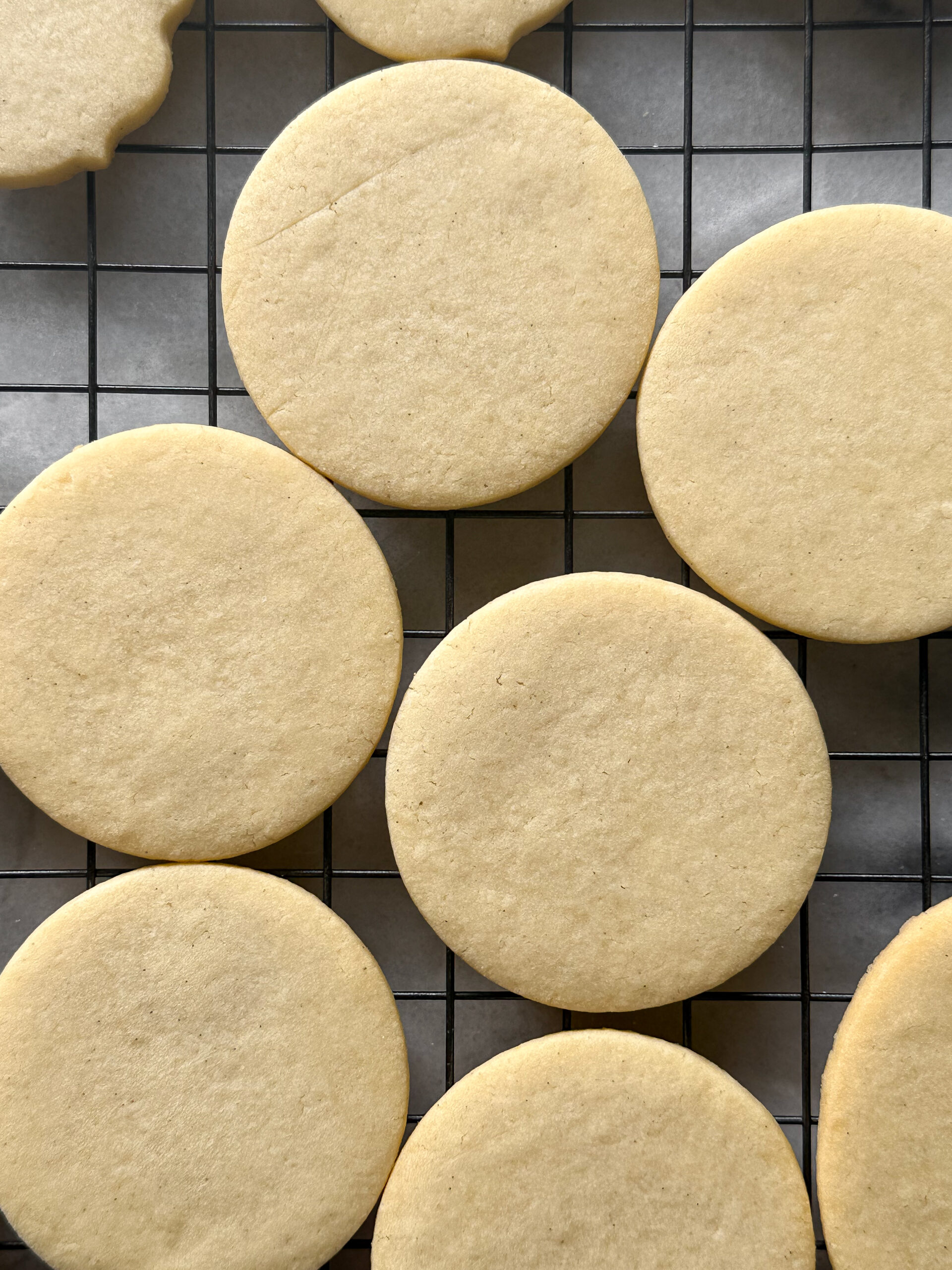
ingredients in buttery cut out cookies
- butter– I always use unsalted butter in my recipes so I can accurately tell you how much salt to add, but the truth is that when I’m just baking personally, I use salted butter and nothing is ever too salty. Use what you have, but make sure that it has come to room temperature, about 66-70 degrees. Butter straight out of the fridge will not cream as well, which will either require too much creaming (creating too aerated of a mixture) or the final dough will have little pebbles of butter that will melt in the oven, causing uneven cookies. Make sure the butter hasn’t softened too much and become melty or squishy. See the FAQ section for more help about butter temperature.
- sugar– I use granulated sugar in my sugar cookie recipe. This recipe has a little less sugar than a typical sugar cookie recipe, but just enough to give the cookie the perfect sweetness and texture.
- flour– Flour provides the structure for this cookie, and this recipe has the perfect amount for the dough to both hold its shape, yet not be too floury and hard.
- cornstarch– Adding a small amount of cornstarch to a dough will make the final cookies a bit softer and more tender while also helping the cookies hold their shape.
- egg– An egg will give the cookie structure and tenderness. A whole egg is the simplest choice and works perfectly here. However, if you want the best flavor and texture in your final cookies, try using two egg yolks instead of one whole egg. It’s incredible and what I prefer. Of course, I understand the annoyance of having two extra egg whites you don’t know what to do with, so here are a few recipes to try out with those extra whites!
- salt- Diamond Crystal kosher salt is the best for baking, so I recommend grabbing a box if you can. It will last you for a long time if you just use it for baking! If you don’t have this type of salt, swap for regular table salt and use half the amount called for.
- vanilla– Vanilla is essential for flavor in this recipe, and I recommend using vanilla bean paste instead of extract if you can. I love to use vanilla bean paste because the flavor is more intense, but vanilla extract is great as well. I love The Spice House, Heilala, and Nielsen-Massey. (Make sure to check your local Costco store for big jars of Nielsen-Massey at an amazing price!)
- almond extract– I grew up in almond extract loving family, so I was surprised to discover that it is a polarizing flavor. If you are not a fan, swap it for more vanilla or skip it entirely.
*You can use my code EMILYLOGGANS for 10% off at The Spice House. I love to get my vanilla, almond, salt, and spices from there!
supplies needed to make buttery cut out cookies
- hand mixer or stand mixer– A stand mixer makes this process so incredibly easy, but a hand mixer works just fine, especially if you’re just making a single batch.
- spatula– A spatula is essential to scrape down the bowl throughout the process. Without scraping, you’ll end up with an unevenly mixed dough and cookies that are inconsistent.
- scale– If there’s one thing I can convince you of, please let it be a kitchen scale. 🙏🏻Using a scale makes everything easier with baking, and it ensures you get the same results every time. Flour is so easy to over-add with volume measurements, and a scale solves that problem.
- parchment paper– I always roll my dough between two sheets of pre-cut parchment paper, which is by far the best way to roll out dough.
- guided rolling pin– Rolling dough evenly is tricky with a regular rolling pin, but with a guided rolling pin, dough comes out evenly every time. It’s such a time saver and one of my favorite kitchen tools.
- baking sheets– I use these cookie sheets for years, and they are amazing.
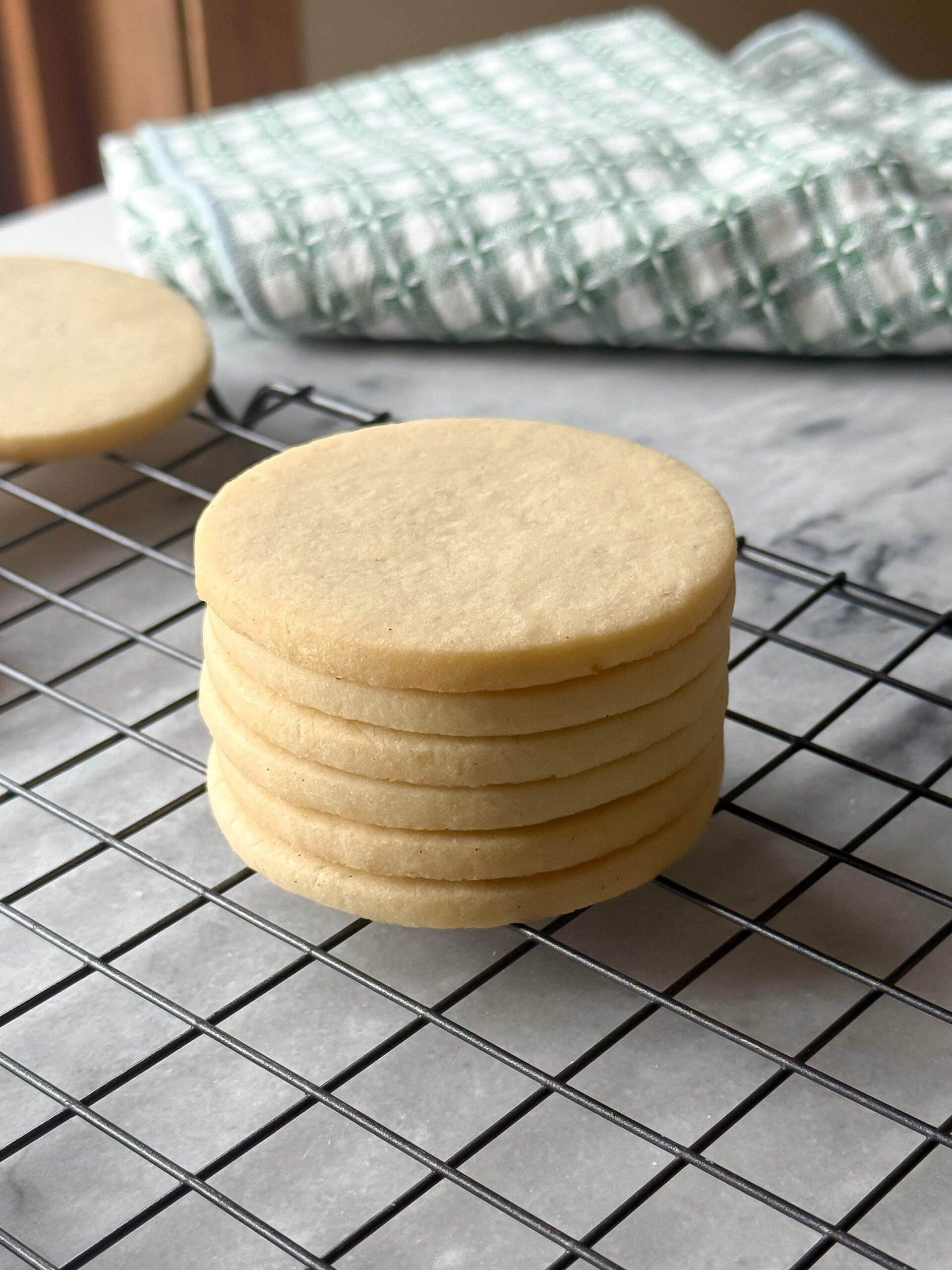
buttery sugar cookie cut out cookies
This cookie is buttery, sweet but not too sweet, crisp edges with a soft chewy center, and delicious baked thin & crisp or thick & soft depending on your preference.
Ingredients
226g unsalted butter (2 sticks ; 1 cup)
150g granulated sugar (¾ cup)
1 tsp salt, Diamond Crystal kosher salt (use ½ tsp for table salt)
2 egg yolks (you could substitute for one whole egg if preferred)
1 tsp vanilla bean paste (or vanilla extract)
1 tsp almond extract (optional)
300g all purpose flour (2 ½ cups)
10g cornstarch (1 tbsp)
Instructions
In the bowl of a stand mixer fitted with the paddle attachment (or mixing bowl), cream the butter, sugar, and salt on low to medium-low speed until combined and slightly lightened. Scrape the sides and bottom of the bowl to ensure there are no under-mixed bits.
Decorate how you would like with buttercream or royal icing.
Add the egg, vanilla, and almond extract and mix until fully combined and emulsified.
Add the flour and cornstarch all at once and mix on low speed until the mixture starts to form a dough. Scrape the sides and bottom of the bowl to make sure there are no dry bits of flour.
Drop the dough onto lightly floured parchment paper. Gently form the dough with your hand into a smooth disc before lightly flouring the top of the dough. Place a second piece of parchment paper over the top of the dough and roll it to ¼″ with a guided rolling pin. (Roll to ⅙″-⅛″ for a crisp, thin cookie and roll to 5/16″-⅜″ for a very thick cookie.)
Refrigerate the sheet of dough for two hours or overnight.
When ready to bake, preheat the oven to 400 F.
Cut shapes from the chilled dough with lightly floured cookie cutters, placing the cut cookies on a parchment lined baking sheet. Chill the cookies in the refrigerator for 10-15 minutes or in the freezer for 5 minutes before baking. Bake the cookies for 8-10 minutes, or until the tops are no longer shiny. The size and thickness of the cookies will determine how long they bake, so pay attention to the surface and the bottoms of the cookies. The surface should be no longer shiny, and the bottoms should be slightly golden brown.
Cool the cookies on the cookie sheet for a few minutes before transferring them to a wire rack to cool completely before decorating. Moving them prematurely can result in broken cookies.
FAQs
- Why did my cookies spread? A little spread (about an eighth of an inch around) is normal. Too much spread that causes the cookies to be misshapen is frustrating and can ruin the process when you want to decorate. Spread can happen for a few reasons: 1) You used too little flour in the dough. Did you weigh it? 2) What size were your eggs? This recipe is formulated for large sized eggs. Extra large eggs add a lot of additional moisture. 3) You didn’t chill the dough for long enough. The initial chill time is important for the butter to chill enough and for the flour to hydrate. Baking them right away will definitely cause them to spread. Additionally, that mini chill time in the freezer before baking is very helpful for holding their shape.
- Why was my dough crumbly and dry? Did you weigh your flour? It is very easy to accidentally add too much flour when measuring with cups. Too much flour will make a dry, crumbly dough. Did you add enough sugar? Do you have the right amount of butter? What size are your eggs? This recipe is formulated for large sized eggs. Medium or small eggs will not provide enough moisture to the dough.
- Can I use table salt instead of Diamond Crystal kosher salt? Absolutely! Just use half the amount called for since the flakes of diamond crystal are larger, which accounts for less volume in the measuring spoon. I do recommend purchasing a box of diamond crystal, especially if you’re a baker or like to cook. It’s truly the best and recommended by chefs.
- Is Morton kosher salt the same as Diamond Crystal kosher salt? No, and I don’t recommend you use Morton kosher salt in baking.
- Does my butter need to be room temperature or softened? Room temperature is ideal for this recipe. Cold butter will not mix properly, and softened butter will make a dough that is very soft and sticky. Do not use melted butter.
- What should I do if my butter is cold from the fridge? If your butter is cold right out of the fridge, but you want to bake right now, there are a few options. 1) Microwave the butter as whole sticks on defrost mode for a few seconds at a time until it becomes pliable. 2) Chop the butter into small pieces and set off to the side until you can indent the butter with your finger.
- Why is the oven temperature so hot? I like to bake these cookies at 400 F, which is a hotter temperature than most sugar cookie recipes call for. I like a slightly golden brown bottom to my cookies while keeping the centers softer, and 400 F provides both of those things since the cookies can caramelize more quickly. Using a lower oven temperature like 350 F would take longer to caramelize the bottoms while then drying out the centers of the cookie. Also, baking at 400 F sets the proteins in the eggs more quickly, which actually helps the cookies hold their shape even better. This temperature is too hot for a cookie with more sugar, though. Since this is a butter-forward recipe, it works. But in a sugar-forward recipe, it creates cookies that are too hard.
- Why are my cookies getting too golden brown on the bottom? If you prefer a softer colored bottom, and you find that the cookies are just browning too much for you while they still need to bake to not be underdone, lower the oven temp to 375 F.
- Why do my cookies have a shiny, see-through-like patch on the bottoms? That is the sign of an underdone (raw) cookie. It needs to bake more. Before pulling cookies out of the oven, check to make sure the tops are evenly “dull” and not shiny.
- How can I bake these to be thin and crisp? Roll the dough to ⅙″ or ⅛″ and bake at a lower temperature for a longer time. If you bake them at 400 F, it might be too hot and brown them way too quickly before they had a chance to dry out enough to become crisp. Thin and crisp cookies are usually baked at 325 F, but I would start with 350 F.
- Do I really need a kitchen scale? Kinda, yeah? 🙃 They’re not very expensive, but it is a life changing kitchen investment. Here’s the one I use.
- Can I bake my cookies on silicone mats instead of parchment? You can, and I recommend perforated silicone mats if you have them. They make such nice bottoms to cookies. However, I still prefer to bake with parchment. It’s my preference, but your preference could be to use silicone mats. Just experiment and go with what you prefer based on experience and results. 🫶🏻
- Can I decorate these cookies with royal icing or buttercream? Yes! They are delicious with both. Here is my royal icing recipe.
- Is this the same recipe you used to sell on the old website? This recipe has gone through SO MANY changes over the years. I just keep changing things here and there. So, no. It is not the exact same. I used to use cake flour, but I have since changed it to regular all purpose flour with a little cornstarch for similar results. Cake flour is crazy expensive and hard to find, and I want these cookies to be low maintenance. Also, I found the cake flour made the cookies a little too tender. I also used to use 100g of sugar. I eventually raised it to 125g and realized I liked the tenderizing and sweetness. I raised it a little more to 150g and realized I loved the extra chew in the center. A typical sugar cookie recipe is 200g of sugar to the amount of butter in this recipe, but I’ve found that 150g is perfectly in the middle. I used to add baking powder, but have since cut it because I don’t think it is necessary in this cookie. I used to call for one whole egg, but since trying two egg yolks, I’ve fallen in love with that. You can still use a whole egg if you prefer, and I still do that sometimes if I don’t want any extra whites. It’s just good to know that one is even better than the other so you can make an informed choice.